
Top Reps
Replica Sneakers Buying Guide: Size, Quality Checks, Shipping, Refunds, and Buyer Risk
Nov
People search for replica sneakers for different reasons. Some want the look of a popular release at a lower price. Others are comparing materials, trying a style before spending more on an authentic pair, or looking for everyday footwear with a familiar silhouette. Whatever the reason, the useful questions are practical: Will the shoes fit? Does the quality match the listing? How long will delivery take? What happens if the pair is wrong, damaged, or not as described?
"Replica" is also an imprecise word. It may refer to an unbranded shoe inspired by a popular design, a product that imitates a branded model, or an unauthorized item using another company's logos and packaging. Those categories can differ in quality, legality, platform eligibility, and return rights. Buyers should identify what a listing actually offers rather than relying on the label alone.
What does "replica sneakers" mean?
In everyday sneaker discussions, "replica" can describe several different products. The term does not by itself tell you what materials were used, how closely the product matches a reference pair, or whether a brand authorized the production.
A listing may describe itself as:
- Unbranded or inspired: A shoe that takes general design cues from a popular style without using another company's name or logo.
- Branded replica: An unauthorized product that reproduces a brand's marks, model identity, packaging, or signature details.
- Factory overrun or unauthorized stock: A seller's description that may or may not be supported by verifiable documentation. "Factory" language is not proof of origin.
- Custom or modified: An authentic or unbranded base shoe that has been altered after production.
- Used or imperfect: A pair with wear, cosmetic defects, or missing accessories, which should be described clearly before purchase.
These labels are not interchangeable. A buyer comparing two listings should ask what is actually included: the shoes, box, extra laces, tags, insoles, and any claimed documentation. The buyer should also ask whether the product is intended for casual wear or performance use.
How to choose the right size
Size is one of the most common reasons an online sneaker order fails. A label such as US 9 or EU 42 is only a starting point. Internal length, forefoot width, toe-box shape, heel padding, insole thickness, and the shoe's last all influence how the pair fits.
Measure both feet
Measure your feet at the end of the day, when they may be slightly larger than in the morning. Place a sheet of paper on a hard floor. Wear the socks you expect to use with the shoes, stand naturally, and mark the furthest point of the heel and longest toe. Measure the distance in millimeters and repeat for the other foot.
Use the longer foot as the minimum length reference. If one foot is wider, use the wider foot when assessing the forefoot. Keep the measurements available when you contact the seller.
Ask for product-specific measurements
A useful size conversation should cover more than "true to size." Ask for:
- Insole length in millimeters.
- Insole width or internal forefoot width.
- Whether the insole measurement is removable or fixed.
- The size system used in the listing.
- The seller's recommendation for narrow, standard, or wide feet.
- The size-exchange deadline and conditions.
A seller may not be able to provide perfect internal measurements for every pair, but the response should be specific enough for you to understand the basis of the recommendation. A generic chart copied from another product is less useful than a measurement from the actual model.
Separate length from width and volume
If your toes touch the front, the issue is likely length. If the sides of your forefoot feel compressed, the issue may be width. If the top of your foot is under pressure, the shoe may lack volume even if the length is correct.
Sizing up may add length without solving width. It can also create heel movement. If the seller offers only a longer size rather than a wider fit, compare the insole shape and consider whether the model is suitable for your foot.
Casual use versus sports use
For casual wear, buyers can make more personal choices about room and structure. For running, basketball, training, hiking, or long shifts, a replica sneaker's appearance should not be treated as evidence of performance. Cushioning, torsional support, traction, upper stability, and durability may differ substantially from the original design.
If you intend to use the pair for a demanding activity, ask what the shoe is designed for and inspect the outsole pattern, heel structure, midsole firmness, and upper reinforcement. Do not choose solely by the name of a reference model.
Quality checks before ordering
Quality checks are most useful when they compare the listing with the actual product. They cannot prove every aspect of origin, but they can reveal unclear descriptions, inconsistent construction, and poor value.
Start with the listing, not the logo
Review the complete product page before focusing on small visual details. Check whether the listing explains:
- Upper, lining, midsole, and outsole materials.
- Available sizes and actual stock status.
- Product measurements or a model-specific size chart.
- Shipping origin and processing time.
- Return conditions and refund timing.
- Included accessories and packaging.
- Whether the product is new, used, customized, or imperfect.
Product descriptions that rely only on phrases such as "best quality," "premium batch," "top version," or "1:1" provide little technical information. Such phrases may be meaningful within a particular seller community, but they are not standardized quality grades.
Request current photographs
Ask for photographs of the actual pair when the listing does not already provide them. Useful angles include the front, lateral side, medial side, rear, outsole, insole, tongue, inner size label, and box or packaging.
Current photographs help answer several questions at once: Is the item in stock? Do the left and right shoes look consistent? Are there visible defects? Does the actual pair match the catalog images? Are the materials and color placement consistent with the description?
Inspect symmetry and panel alignment
Compare the left and right shoes from the same angle. Look at the toe shape, eyestay alignment, heel height, panel edges, and position of decorative elements. Small manufacturing variation can occur in ordinary footwear. Large differences in shape or panel placement suggest inconsistent construction.
When comparing a replica to a reference image, remember that lighting and camera perspective can change color and shape. Treat a single low-resolution photograph as weak evidence. Look for patterns across several views.
Inspect stitching
Stitching should generally follow the edge of the panel with reasonably even spacing. Look for skipped stitches, loose threads, sudden changes in stitch length, and seams that stop before the panel edge.
Not every loose thread means the shoe will fail. The more important questions are whether the stitching appears structural, whether stress points are reinforced, and whether the same issue appears on both shoes. A decorative seam and a load-bearing seam should not be judged in exactly the same way.
Inspect bonding and sole attachment
On cupsole and vulcanized shoes, examine the joint between the upper and outsole. Look for open gaps, lifting at the toe or sides, excessive adhesive, and uneven sole height. On injection-molded or foam-based designs, inspect the transition between the upper, midsole, and outsole.
A small amount of adhesive may be cosmetic. Repeated gaps, visible lifting, or a sole that is not seated evenly can affect durability. If the shoe arrives with a strong chemical smell, leave it in a ventilated area before deciding whether it is suitable for wear. If the odor persists or causes irritation, do not use the pair.
Inspect materials realistically
Ask whether the upper is leather, synthetic leather, mesh, knit, canvas, or a combination. Do not assume that a visual texture proves a material's identity. Leather and synthetic leather can look similar in photographs while differing in breathability, crease behavior, care requirements, and longevity.
For mesh and knit shoes, examine reinforcement around the toe, eyestay, and heel. For leather-style shoes, check the edge finish, flexibility, and whether the material feels consistent across panels. For canvas shoes, inspect the stitching where the upper meets the foxing or outsole.
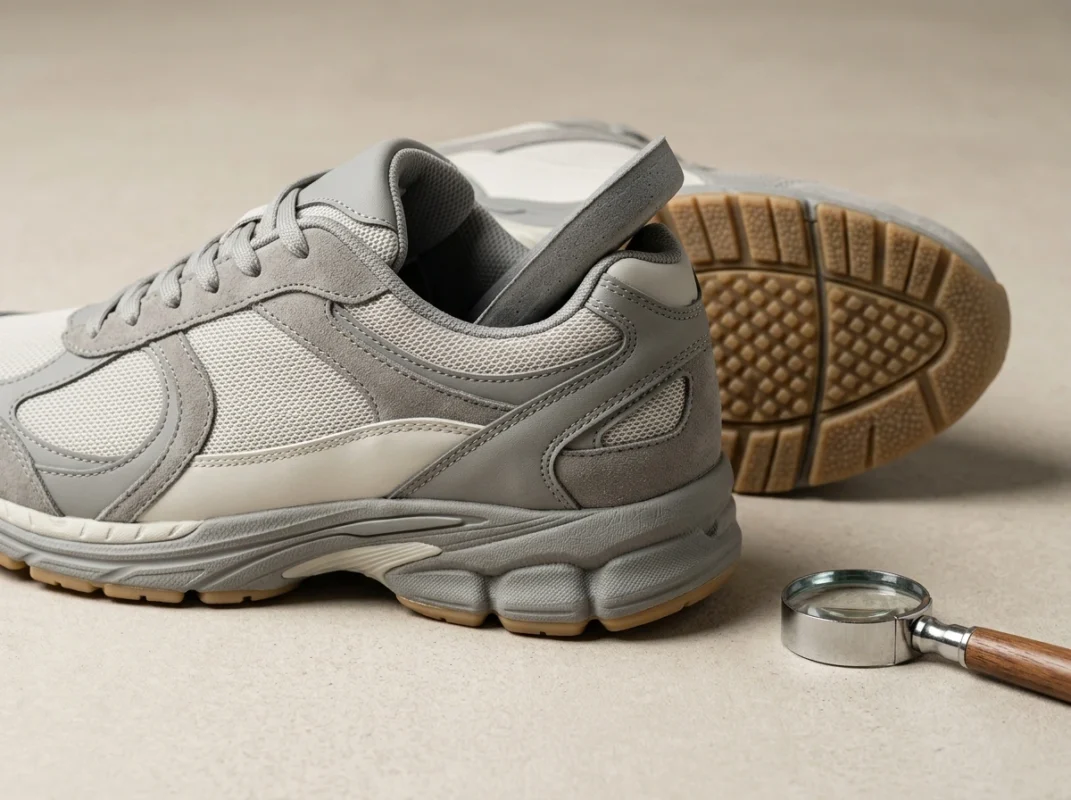
Inspect the insole and outsole
The insole affects comfort and internal volume. Ask whether it is removable and compare its length with your foot measurement. A thick insole can make a shoe feel soft but reduce usable space.
The outsole should match the intended use. A smooth lifestyle outsole may be adequate for dry pavement but not for wet surfaces or sport. Check tread depth, flex points, rubber coverage, and the firmness of the heel. If you plan long walks, also look at the midsole's stability and whether the shoe twists excessively.
Packaging and labels are supporting details
Boxes, tags, QR codes, and printed labels can help compare what was promised with what was delivered. They should not be treated as standalone proof of quality or authorization. Packaging can be replaced, codes can be copied, and accessories can be separated from the shoes.
For a buyer, the useful question is whether the entire product is consistent: description, photographs, materials, measurements, construction, condition, and included items.
How seller quality affects buyer experience
The seller is part of the product experience. Two listings for visually similar shoes may produce very different outcomes because one seller provides measurements, realistic photos, accurate shipping information, and a workable return process.
Before ordering, check:
- Whether the seller provides a clear business or store identity.
- Whether contact information is usable and monitored.
- Whether the product page states where the order ships from.
- Whether reviews contain specific comments about fit and construction.
- Whether the seller answers material and measurement questions.
- Whether the return policy is available before payment.
- Whether the checkout creates a clear order record.
Reviews should be read for details rather than star ratings alone. Look for comments about actual size, width, comfort after several wears, sole durability, delivery time, and whether the delivered pair matched the listing. The FTC recommends checking reviews critically across multiple sources and keeping records of the seller's promises.
No seller can remove every risk from an international or uncertain purchase. The goal is to make the remaining uncertainty visible before payment.
Shipping: domestic, international, and total cost
Shipping affects cost, delivery time, customs exposure, and the practical difficulty of a return. A website's language or currency does not necessarily identify the dispatch country.
Calculate the landed price
Use this formula before deciding whether a pair represents good value:
Product price + shipping + taxes + duties + payment fees + possible return postage = estimated total cost
A low product price can become less attractive when shipping is expensive, taxes are collected on delivery, or the return route requires international postage.
Check the dispatch and processing time
Distinguish between processing time and transit time. "Ships in 7–10 days" may mean the order is prepared in that period before the carrier receives it. Ask when tracking will be created, when the first carrier scan should appear, and what happens if stock is unavailable.
A tracking number is not the same as a moving parcel. Check updates through the carrier's official website and save the tracking history if a delay develops.
Understand customs and import rules
International orders may be subject to customs inspection, duties, taxes, or additional carrier fees. The rules depend on the destination, product description, declared value, and applicable law. A buyer should not assume that a small parcel is exempt from inspection or that a personal-use order is treated the same way in every country.
Do not ask a seller to provide a false description, inaccurate value, or misleading gift designation. Such requests create additional uncertainty and can weaken your position if the parcel is delayed or questioned. If a customs authority or carrier contacts you, verify the request through an official channel and consider location-specific professional advice for a formal notice.
Refunds, exchanges, and payment records
A refund policy matters most when the size is wrong, the product is damaged, the wrong color arrives, or the delivered pair differs materially from the listing. Read the policy before ordering rather than after a problem occurs.
Check:
- How many days you have to open a return request.
- Whether the deadline begins at purchase, shipment, or delivery.
- Whether size exchanges are available.
- Whether the item must be unworn and in original packaging.
- Who pays return postage.
- Whether an international return is accepted.
- Whether sale items have different conditions.
- Whether a restocking fee applies.
- How long a refund takes after the return is received.
- What evidence is required for a wrong or damaged item.
The FTC advises online shoppers to keep the company name, website, order details, amount paid, return policy, shipping promise, and communications with the seller. It also recommends using a payment method with a dispute process when possible.
Before wearing the shoes outdoors, inspect them indoors and compare them with the saved listing. Photograph the packaging, labels, accessories, outsole, insole, and any defects. If you need an exchange or refund, open the request within the published period and follow the stated instructions. Keep the return tracking number and proof of delivery.
A payment dispute is not an automatic refund. The payment provider may review the listing, correspondence, delivery record, and evidence of the problem. Use accurate descriptions of what happened and do not submit a claim that says the order never arrived if it did arrive.
Buyer risk: what to understand before ordering
A neutral guide should acknowledge risk without treating every buyer as uninformed. The main risks are predictable and can be grouped into five areas.
Fit risk
The product may run smaller, wider, narrower, or differently shaped than expected. This is why foot measurements, insole measurements, and a clear exchange policy matter.
Quality variation
Pairs described with the same batch or version language may still vary. Materials, stitching, glue, shape, and finishing can change between production runs. Product photographs may show a sample rather than the exact pair shipped.
Delivery risk
Processing can take longer than the advertised estimate. Tracking can remain inactive, parcels can be delayed, and international orders can involve customs or carrier fees.
Refund risk
A seller may offer a written policy but make the return difficult in practice. International return postage can cost a large share of the original order. Some payment methods provide little practical recovery if the seller stops responding.
A practical pre-order checklist
Before paying, confirm the following:
- I know my longer foot's length and width in millimeters.
- I have checked the exact model's measurements rather than relying only on a generic size label.
- I know the upper, lining, midsole, and outsole materials.
- I have seen current product photos or understand that the photos are catalog images.
- I know whether the pair is intended for casual wear or performance use.
- I know the dispatch country and realistic processing time.
- I have calculated shipping, taxes, duties, and possible return postage.
- I have read the size-exchange and refund conditions.
- I know how customer support can be reached.
- I will keep the product page, order confirmation, payment record, and tracking information.
- I understand the laws and platform rules that apply to my location.
If several answers are unclear, the issue is not necessarily that the product is poor. It means the purchase has unresolved uncertainty. You can ask for more information, choose a listing with better documentation, or decide that the uncertainty is not worth the price.
Final thoughts
Buying replica sneakers is not a single type of transaction. The outcome depends on the specific product, seller, materials, fit, shipping route, payment method, and destination rules. A lower price may be meaningful, but it should be evaluated alongside uncertainty about quality, delivery, refunds, and legal treatment.
The most useful approach is methodical rather than emotional. Measure your feet. Ask for product-specific information. Inspect construction and materials. Calculate the complete delivered cost. Read the return policy before paying. Save the evidence needed to resolve a problem.
Frequently asked questions
Do replica sneakers fit the same as authentic sneakers?
Not necessarily. Even when a replica follows the same general silhouette, the last, padding, insole, materials, and manufacturing tolerances can differ. Use your foot measurement and request model-specific insole measurements.
Is "1:1" a standardized quality grade?
No. "1:1" is a seller or community term, not an independent technical certification. Ask what the seller means by the claim and compare the actual materials, measurements, construction photographs, and return terms.
Should I size up if I am between sizes?
Not automatically. First identify whether you need additional length, width, or volume. Sizing up can solve a short toe box but create heel movement. Compare the insole dimensions with a pair that already fits you well.
Are replica sneakers suitable for running or sports?
Appearance does not establish performance. A pair may be acceptable for casual wear but lack the cushioning, traction, stability, or durability required for sport. For demanding activities, choose footwear designed for that activity and assess the construction accordingly.
How can I tell whether the seller's product photos are current?
Ask for photographs of the actual pair from specific angles, preferably with a simple timestamp or order reference. Catalog images can be useful for color and shape, but they do not confirm the condition of the pair you will receive.
What should I do if the size is wrong?
Check the return or exchange deadline immediately. Keep the shoes unworn outdoors, photograph the pair and packaging, contact the seller through the official order channel, and follow the written return instructions. Keep tracking information for any authorized return.
What is the difference between an inspired shoe and a branded replica?
An inspired or unbranded shoe uses general design references without presenting itself as another company's product. A branded replica may reproduce protected names, logos, packaging, or model identifiers without authorization. The distinction can affect legal treatment, platform rules, and the buyer's expectations.

If you want to view our requirements for reps sneakers and understand the quality check criteria, please click here.